
Sort ideas before writing
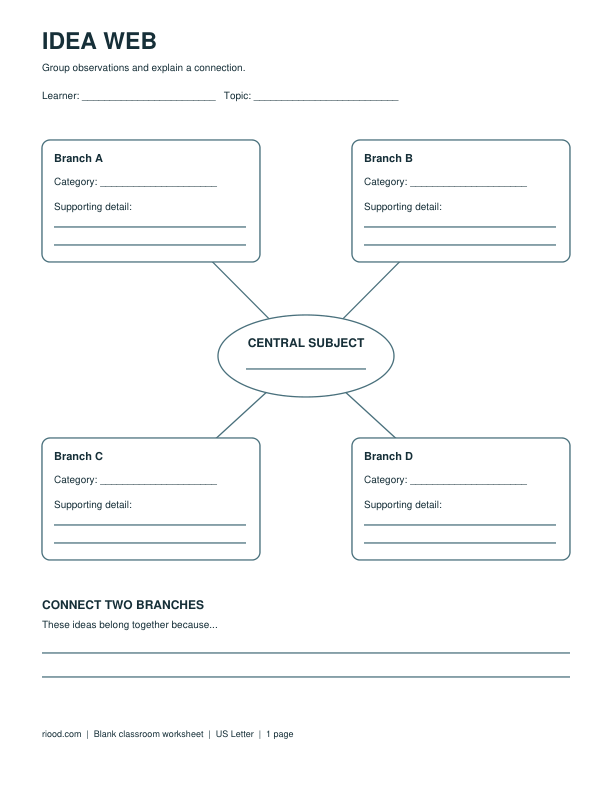
A pupil has collected facts but cannot see which ones belong together. An idea web makes those connections visible before writing. Put one subject in the centre, choose four branches, and place a supporting detail under each branch. The free PDF has a central oval, four connected boxes, and a final prompt for explaining a relationship.
Give each branch a different job
For a classroom discussion about a school garden, the centre might say School garden. The four branches could be Plants, Tools, People and Seasons. These are suggested categories, not answers printed on the worksheet. Pupils supply their own observations, underline a detail they can explain, and add a question beside a branch that needs more investigation. They can use fewer than four branches when the topic is small.
Turn the web into an explanation
Ask the learner to point to two branches and explain how they connect. A tool might help a person complete a seasonal task. The sentence space at the bottom captures that connection in words. This step helps a teacher distinguish a collection of copied labels from an explanation the learner understands. Keep the first web as a planning sheet; a finished paragraph belongs on separate paper.
Download and print
The download is one blank US Letter PDF in portrait orientation. Preview the page and choose fit to printable area if your printer clips the outside border. It has no interactive fields; write by hand after printing. The boxes deliberately leave space for short phrases and small sketches.
When the existing pack helps
This free sheet focuses on branching ideas. The existing Graphic Organizer Pack is listed at $5 and includes KWL, T-chart, story map, Frayer model, five-W questions and essay planning sheets, with Word versions where listed. Choose it when a lesson needs several organizer types or editable text. The two new free diagrams are separate downloads; they are not promised as extra files inside that pack.